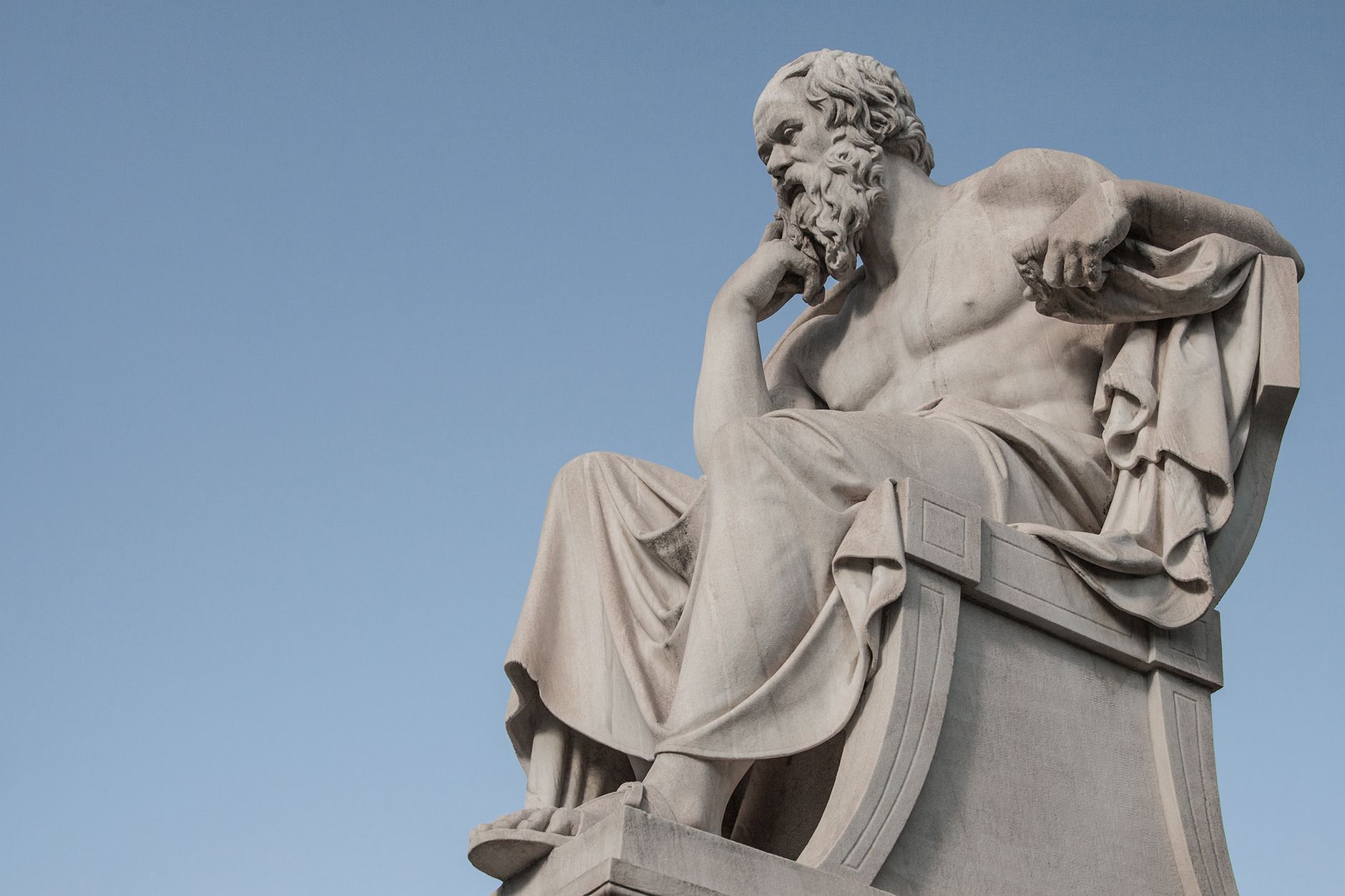
Socrates (c. 470–399 BCE)
Socrates was an Athenian philosopher widely regarded as one of the founders of Western philosophy. He taught through questioning rather than writing books, challenging people to examine their beliefs about truth, justice, courage and virtue. His method, known as the Socratic method, continues to influence education and philosophy. He was sentenced to death in Athens and became a lasting symbol of intellectual courage and integrity.
1. Question What You Think You Know
Socrates built his philosophy around questioning. He discovered that people often speak confidently about justice, courage, love or virtue without truly understanding them. His greatest lesson is simple: confidence is not knowledge. Before defending your beliefs, ask why you hold them. The beginning of wisdom is recognising that your understanding may be incomplete and remaining willing to examine it.
2. Admit What You Do Not Know
“I know that I know nothing.” — commonly associated with Socrates
The exact popular wording is a simplification, but Socrates repeatedly emphasized awareness of one’s own ignorance. He considered false certainty more dangerous than honest uncertainty. A person who knows nothing but admits it can learn. A person convinced that he already knows everything closes the door to wisdom. Intellectual humility is not weakness; it is the beginning of genuine learning.
3. An Unexamined Life Is Dangerous
“The unexamined life is not worth living.” — Plato, Apology
Socrates believed human beings should regularly examine their beliefs, actions and values. Living automatically means allowing habit, society and fear to decide who you become. Ask yourself why you want what you want and whether your actions match your principles. Self-examination can be uncomfortable, but without it, you may spend years successfully pursuing a life you never consciously chose.
4. Ask Questions Instead of Pretending to Have Answers
Socrates rarely offered simple final answers. His method was to ask questions that exposed contradictions and forced deeper thinking. When someone claimed to understand courage or justice, Socrates would investigate what they actually meant. Use this approach in your own life. Before giving advice, making judgments or defending opinions, ask better questions. A thoughtful question can reveal more truth than a confident answer.
5. Wisdom Begins With Intellectual Humility
The wisest person is not necessarily the one with the most information. Socratic wisdom begins by understanding the limits of your knowledge. This protects you from arrogance and keeps curiosity alive. Experts can still be wrong, and experience can create overconfidence. Whenever you become completely certain that you cannot be mistaken, pause. Humility keeps the mind open to evidence, correction and deeper understanding.
6. Do Not Confuse Reputation With Virtue
Socrates lived in a society deeply concerned with honour and public reputation, yet he repeatedly questioned whether appearing good was more important than actually being good. Others may admire you for wealth, power or status while knowing little about your character. Reputation belongs partly to other people’s opinions. Virtue belongs to your actions. Protect your character even when nobody is watching and praise is unavailable.
7. Care for Your Soul Before Your Possessions
In Plato’s dialogues, Socrates repeatedly urges people to care for the condition of their soul rather than obsessing over wealth and status. Material success can improve comfort, but it cannot automatically make you wise or good. Ask whether your pursuit of possessions is improving you or merely expanding what you own. A successful life should develop the person who possesses wealth, not sacrifice that person for wealth.
8. Never Stop Examining Yourself
Self-examination is not a one-time exercise. Your beliefs change, circumstances change and new experiences reveal weaknesses you previously could not see. Socrates teaches us to maintain an ongoing conversation with ourselves. Why did I react this way? What am I afraid of? What do I truly value? Am I being honest? Regular reflection prevents small errors from silently becoming permanent patterns and gives you opportunities to correct yourself.
9. Do Not Follow the Crowd Blindly
Popular opinion is not automatically truth. Socrates frequently challenged accepted assumptions, even when doing so made him unpopular. The crowd can be right, but it can also be careless, emotional or uninformed. Before adopting a belief because everyone around you believes it, examine the reasons yourself. Independent thinking does not mean opposing everyone. It means refusing to let popularity replace evidence, reflection and personal judgment.
10. A Good Question Can Change Your Life
Socrates understood the power of questions because questions disturb automatic thinking. “What is justice?” can expose assumptions about society. “What is success?” can transform a career. “What do I truly know?” can create humility. The questions you repeatedly ask determine what you notice. Instead of asking only how to get what you want, occasionally ask whether what you want deserves to be pursued at all.
11. Truth Is More Valuable Than Comfort
Socrates’ conversations often made people uncomfortable because he exposed contradictions between what they claimed to believe and how they reasoned. Truth can threaten identity, pride and convenience. But a comfortable illusion does not become wisdom because it feels pleasant. Develop the courage to examine information that challenges you. Growth sometimes begins when a truth destroys a belief you wanted desperately to keep.
12. It Is Better to Admit an Error Than Defend One
Socrates teaches that protecting the ego is one of the greatest enemies of learning. Many arguments continue because neither person wants to admit being wrong. But an error admitted can be corrected; an error defended becomes stronger. Change your mind when evidence justifies it. You do not lose intelligence by admitting a mistake. You demonstrate intelligence by valuing truth more than the temporary satisfaction of appearing correct.
13. Do Not Harm Others Even When Harmed
In Plato’s presentation of Socrates, he argues against returning injustice for injustice. Being treated badly does not automatically make wrongdoing justified. Revenge can feel emotionally satisfying while reproducing the very harm you condemn. This does not require passivity or accepting abuse. Seek justice, protect yourself and hold people accountable—but do not let another person’s wrongdoing become permission for you to abandon your own principles.
14. Your Principles Matter Most When They Cost You
Anyone can claim to value honesty, justice or courage when doing so brings rewards. Socrates’ life became a powerful example because his philosophical commitments eventually carried serious personal consequences. Principles are tested when convenience disappears. Before proudly declaring your values, ask what you would sacrifice to protect them. A value that survives only while profitable may be a preference rather than a genuine principle.
15. Never Let Fear Decide What Is Right
Socrates did not claim that difficult decisions were free from danger. His example instead challenges the idea that avoiding consequences should become our highest moral guide. Fear can warn you, but it cannot determine what is just or true. When facing a difficult decision, consider the risks carefully, then ask another question: what would I believe is right if fear were not making the decision?
16. A Life Without Integrity Is a Poor Bargain
Socrates repeatedly placed the condition of one’s character above external advantages. You may gain money, safety or approval by acting against your deepest principles, but what have you become in exchange? Integrity means refusing to divide yourself into a public image and a private reality. Your decisions should allow you to respect yourself. External gain is expensive when the price is permanent damage to your character.
17. Examine Your Definitions
Much confusion begins because people use important words without agreeing on their meaning. Socrates would ask: What exactly do you mean by love, justice, courage, freedom or success? Two people can argue passionately while discussing entirely different definitions. Before debating conclusions, clarify the terms. This simple habit improves conversations, relationships and decision-making. Clear thinking begins when vague words are no longer allowed to hide vague ideas.
18. Conversation Can Be a Path to Wisdom
Socrates did not present philosophy as something learned only through memorizing lectures. His method was dialogue. Through questioning and answering, people could discover contradictions, clarify ideas and examine assumptions together. Choose conversations that make you think rather than merely confirm what you already believe. The best discussion is not always the one you win. Sometimes the greatest conversation is one that leaves you wiser than before.
19. Do Not Pretend to Be Wise
Socrates was deeply suspicious of false expertise. People often speak with certainty because uncertainty appears weak. But pretending to know can cause greater harm than admitting ignorance. This is especially important when giving advice. If you do not know, say so. If the evidence is uncertain, acknowledge uncertainty. Honesty about your limits builds trust and leaves room for learning. Pretended wisdom only makes correction harder.
20. Care More About Becoming Good Than Looking Good
Socrates challenged the human obsession with appearances. We invest heavily in looking successful, intelligent, attractive and important. Yet the inner person may receive far less attention. Ask whether your public image reflects your actual character. Being admired is not the same as being worthy of admiration. Spend at least as much energy improving your honesty, courage and judgment as you spend managing how others perceive you.
21. No One Can Think for You
A teacher can ask questions, provide knowledge and challenge your assumptions, but genuine understanding cannot simply be transferred into your mind. Socrates used questioning partly because he wanted others to think for themselves. Do not outsource every important judgment to experts, leaders or popular opinion. Learn from knowledgeable people, but remain intellectually responsible. Ultimately, you must examine the reasons behind the beliefs guiding your own life.
22. A Difficult Truth Is Better Than a Comfortable Illusion
People often avoid questions because they fear what the answers may reveal. You may discover that a relationship is unhealthy, a goal is meaningless or a belief is poorly supported. Ignoring these realities does not remove them. Socratic examination asks us to face uncomfortable truths before they become larger problems. Temporary discomfort can produce long-term freedom. A comforting illusion may feel safe while quietly controlling your life.
23. Death Is Not the Only Thing to Fear
Socrates’ trial and death gave his philosophy extraordinary force. In Plato’s Apology, he argues that fearing death as certainly evil claims knowledge we do not possess. We know less about death than we imagine. But living unjustly, dishonestly or cowardly can damage character during the life we certainly have. Do not allow fear of losing life to make you forget how to live it well.
24. The Greatest Victory Is Over Your Own Ignorance
Winning an argument does not necessarily mean discovering truth. Socrates sought examination rather than applause. The real opponent is often your own ignorance, prejudice, pride and unwillingness to learn. When someone proves you wrong, treat it as an opportunity rather than humiliation. You have not become less intelligent because you discovered an error. You have become less mistaken—and that is a genuine form of progress.
25. Make Your Life Answer the Question
Socrates left no philosophical writings of his own; much of what we know about him comes from others, especially Plato and Xenophon, so we must distinguish the historical Socrates from later portrayals. Yet his enduring challenge remains clear: do not merely discuss virtue—live it. Do not merely praise wisdom—seek it. Do not merely ask what a good life is. Make your daily choices an answer.
Leave a Reply